Topics
-
Biotech Innovation

Biotech Innovation

Originally written in sris.blog We moved to a new office and our employees were going gaga about the new work…See more
Editors pick
- The story of Corning’s Gorilla Glass is a fascinating example.
- For decades, the potential of this toughened glass remained largely untapped.
- The turning point came when Steve Jobs, the co-founder of Apple Inc.
- The collaboration between Apple and Corning proved to be a monumental success. See all articals
Watch and Listen
-
Breakthrough Engineering
Breakthrough Engineering
The $50M Trust Problem: Why Fortune 500 Companies Won't Bet on AI Predictions Every VP of Engineering knows the prototype…See more
Editors pick
- The story of Corning’s Gorilla Glass is a fascinating example.
- For decades, the potential of this toughened glass remained largely untapped.
- The turning point came when Steve Jobs, the co-founder of Apple Inc.
- The collaboration between Apple and Corning proved to be a monumental success. See all articals
Watch and Listen
-
Business Architecture
Business Architecture

In a recent article titled "I love electric vehicles – and was an early adopter. But increasingly I feel duped,"…See more
Editors pick
- The story of Corning’s Gorilla Glass is a fascinating example.
- For decades, the potential of this toughened glass remained largely untapped.
- The turning point came when Steve Jobs, the co-founder of Apple Inc.
- The collaboration between Apple and Corning proved to be a monumental success. See all articals
Watch and Listen
-
Case Studies
Case Studies
In the world of power tools, innovation is the key to staying ahead of the competition and meeting the evolving…See more
Editors pick
- The story of Corning’s Gorilla Glass is a fascinating example.
- For decades, the potential of this toughened glass remained largely untapped.
- The turning point came when Steve Jobs, the co-founder of Apple Inc.
- The collaboration between Apple and Corning proved to be a monumental success. See all articals
Watch and Listen
-
Innovation Leadership
Innovation Leadership
The $50M Trust Problem: Why Fortune 500 Companies Won't Bet on AI Predictions Every VP of Engineering knows the prototype…See more
Editors pick
- The story of Corning’s Gorilla Glass is a fascinating example.
- For decades, the potential of this toughened glass remained largely untapped.
- The turning point came when Steve Jobs, the co-founder of Apple Inc.
- The collaboration between Apple and Corning proved to be a monumental success. See all articals
Watch and Listen
-
Mobility Innovation
Mobility Innovation
The $50M Trust Problem: Why Fortune 500 Companies Won't Bet on AI Predictions Every VP of Engineering knows the prototype…See more
Editors pick
- The story of Corning’s Gorilla Glass is a fascinating example.
- For decades, the potential of this toughened glass remained largely untapped.
- The turning point came when Steve Jobs, the co-founder of Apple Inc.
- The collaboration between Apple and Corning proved to be a monumental success. See all articals
Watch and Listen
-
Podcasts
Podcasts
Collection series - 2021 Want more innovation? Sridhar, Founder & Chief Integrator of Innovation Enabler, discusses creativity and innovation. He…See more

Sridhar DP
Founder's Desk
Editors pick
- The story of Corning’s Gorilla Glass is a fascinating example.
- For decades, the potential of this toughened glass remained largely untapped.
- The turning point came when Steve Jobs, the co-founder of Apple Inc.
- The collaboration between Apple and Corning proved to be a monumental success. See all articals
Watch and Listen
-
Strategic Creation
Strategic Creation
Collection series - 2021 Want more innovation? Sridhar, Founder & Chief Integrator of Innovation Enabler, discusses creativity and innovation. He…See more
Sridhar DP
Founder's Desk
Editors pick
- The story of Corning’s Gorilla Glass is a fascinating example.
- For decades, the potential of this toughened glass remained largely untapped.
- The turning point came when Steve Jobs, the co-founder of Apple Inc.
- The collaboration between Apple and Corning proved to be a monumental success. See all articals
Watch and Listen
Quantum leaps : Latest innovation breakthroughs and stratagies , delivered to your inbox .
The $50M Trust Problem: Why Fortune 500 Companies Won’t Bet on AI Predictions

Wed January, 2026
7 Mins read
Breakthrough Engineering
Innovation Leadership
Mobility Innovation
The $50M Trust Problem: Why Fortune 500 Companies Won’t Bet on AI Predictions
Every VP of Engineering knows the prototype trap.
You spend 18 months building a thermal management system for your new EV battery. $12M in development costs. 47 engineers. Countless design reviews. Finally, you test it—and discover that while the components work individually, the integrated system violates the thermal envelope. The battery hits 87°C under load. It throttles. Performance tanks.
Back to square one.
This is the $100 billion ritual of deep tech R&D. Prototype first. Discover integration problems later. Repeat.
But here’s what’s quietly changing: Physics-AI can now predict that failure before you build the prototype. In weeks, not months. With high accuracy.
The technology works. The data proves it.
So why aren’t Fortune 500 engineering leaders lining up to use it?
The Trust Problem Isn’t Technical
When you tell a 30-year automotive engineering veteran that an AI can validate their battery concept without building anything, you get a look.
Not skepticism about the AI’s capabilities. Not questions about the algorithms.
You get the look that says: “You’re asking me to bet my career on a prediction.”
Because that’s exactly what you’re asking.
Traditional R&D has a brutal but comprehensible logic: build it, test it, know for certain. The prototype is expensive, but it’s real. You can measure it. Touch it. Debug it. When it fails, you understand why.
AI validation flips this entirely.
You’re asking executives to commit $50M to manufacturing scale-up based on computational predictions. No physical prototype. No hands-on testing. Just an AI saying “this concept has an 87% probability of success.”
That’s not an incremental shift. That’s a complete inversion of how engineering decisions get made.
The Prototype Security Blanket
There’s a reason prototypes feel safe, even when they’re expensive.
- Blame diffusion. When a $50M prototype fails, the narrative is clear: “We followed best practices. We built it. We tested it. The data showed X.” The process was correct; the concept just didn’t work.
- Tangibility bias. Engineers trust what they can measure. A physical prototype generates thousands of data points—temperature curves, stress tests, failure modes. An AI model generates a probability score and some cross-domain analogies. One feels like science. The other feels like fortune-telling.
- Career risk asymmetry. Greenlight a traditional R&D program that fails? That’s unfortunate but defensible. Greenlight an AI-validated concept that fails without ever building a prototype? That’s a fireable offense.
The psychological safety of prototypes isn’t rational—it’s organizational. It’s CYA. It’s “nobody ever got fired for following the process.”
The Mental Shift No One Talks About
“Validate then prototype” isn’t just a new workflow. It’s a new epistemology.
It requires believing that computational models can capture enough physics—thermodynamics, materials science, aerodynamics—to predict real-world performance without physical testing.
That’s an enormous ask.
For decades, simulation tools like ANSYS have supported prototypes, not replaced them. They validate what you’ve already decided to build. Physics-AI claims to tell you what is worth building in the first place. That’s not an incremental improvement—that’s a categorical leap.
And it touches the deepest nerve in engineering culture: Are we still engineers if we’re not building things?
If your job becomes “select from 100 AI-generated concepts” instead of “design the breakthrough,” what’s your role? If the AI does the physics reasoning, what’s left for the PhD who spent 15 years mastering thermal dynamics?
This isn’t Luddism. It’s identity threat.
Why This Moment Is Different
But here’s what’s changing the equation: the cost of not trusting AI validation is becoming unbearable.
The graveyard is full, and it’s paved with “perfectly executed” prototypes that never should have been built.
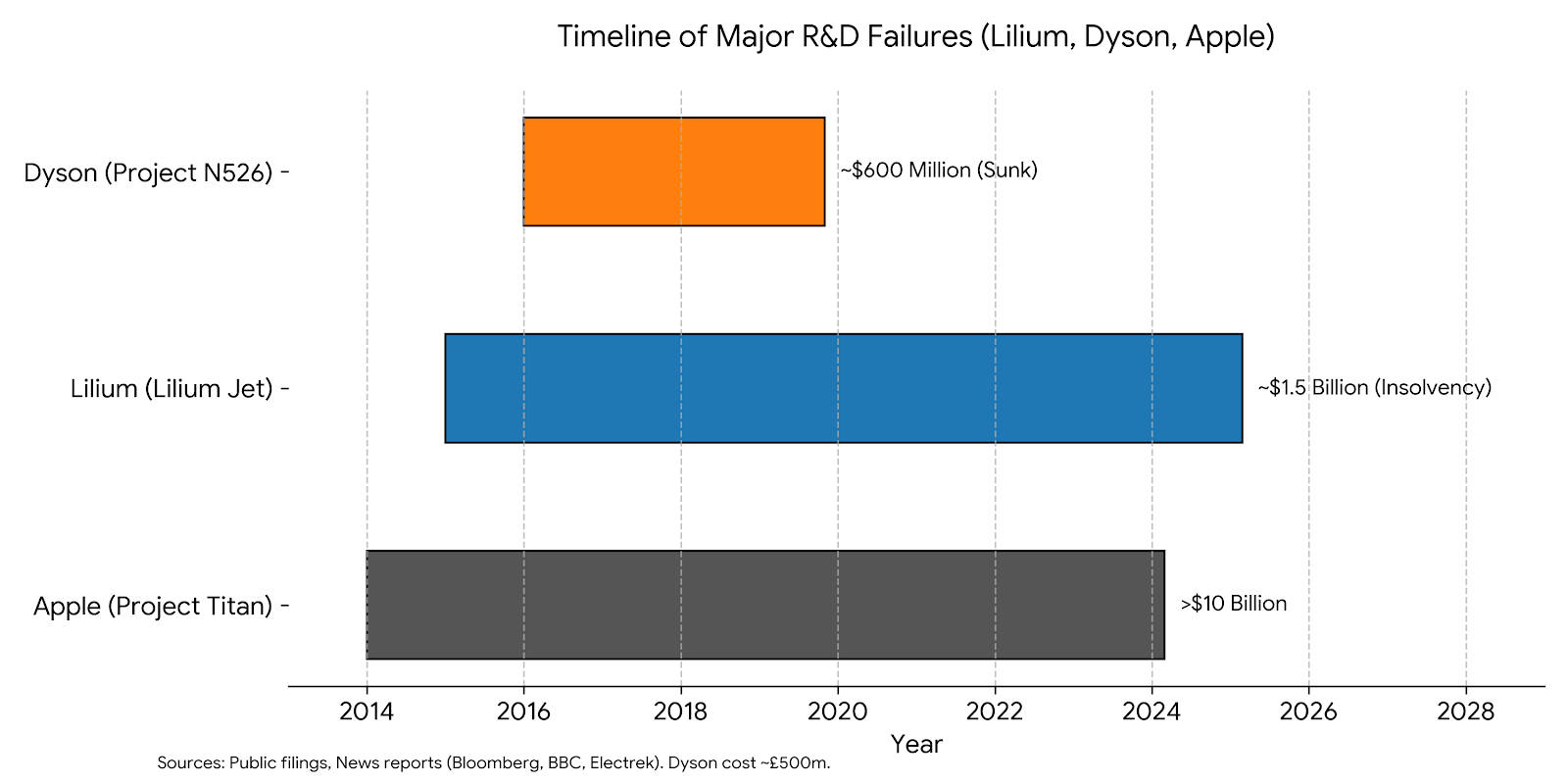
- Lilium spent $1B+ on electric jet propulsion, only to find that current energy density limits made their commercial model unworkable—a physics constraint that was visible on day one.
- Dyson incinerated $600M on an electric vehicle that was engineering perfection but economic suicide—realizing too late that the battery constraints forced a $150,000 price tag just to break even.
- Apple spent a decade and $10B+ on Project Titan, trapped in a loop of autonomous hardware concepts that couldn’t balance thermal envelopes with compute requirements.
These weren’t execution failures. These were Upstream Intelligence failures.
They were billion-dollar bets on fundamentally flawed ideas that traditional prototyping couldn’t catch until the checks were already cashed. Traditional R&D is a sequential queue: build, test, fail, repeat. It’s too slow for a world that demands 500-mile batteries and grid-scale storage.
The companies that crack these problems in the next 3-5 years won’t do it by testing faster.
They’ll do it by validating 40+ concepts in parallel before cutting a single piece of metal.
What Makes Physics-AI Trustworthy Enough
So how do you build trust in a paradigm shift?
Start with “White Box” reasoning.
Engineers don’t trust black boxes. They trust physics. When KRAFT’s Physics-AI validates a concept, it doesn’t just output a probability score. It maps the lineage of the solution.
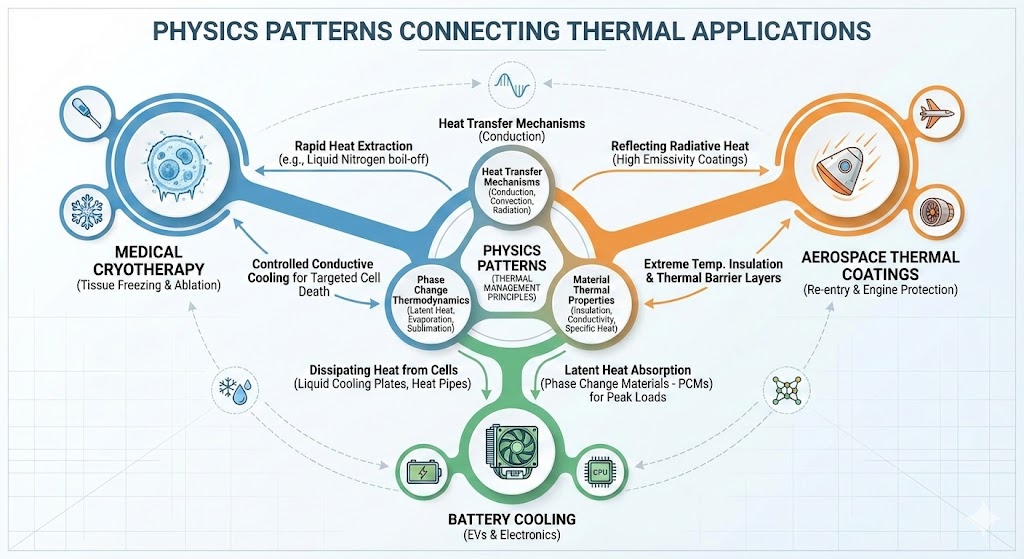
In a recent engagement with a Fortune 500 automotive OEM, the AI surfaced a thermal cooling solution that combined aerospace thermal coatings with medical cryotherapy techniques to achieve 43% better cooling performance.
That’s the “Trust Turn.”
No human engineer would have looked for battery solutions in a medical cryotherapy journal. But the AI didn’t need to “look” anywhere. It recognized the thermal transfer pattern—rapid cooling under constrained geometry—and surfaced every industry that had solved variants of that pattern.
The breakthrough wasn’t in the database. It was in the connection.
Here’s how: KRAFT maintains a Cross-Domain Knowledge Graph—a physics-based map connecting solutions across aerospace, biotech, energy, and semiconductors. Not by keywords. By underlying physics patterns. When you feed it a battery cooling challenge, it doesn’t search for “battery cooling papers.” It identifies the physics constraint: “rapid heat extraction from constrained geometry with minimal energy loss.”
Build trust through progressive proof points.
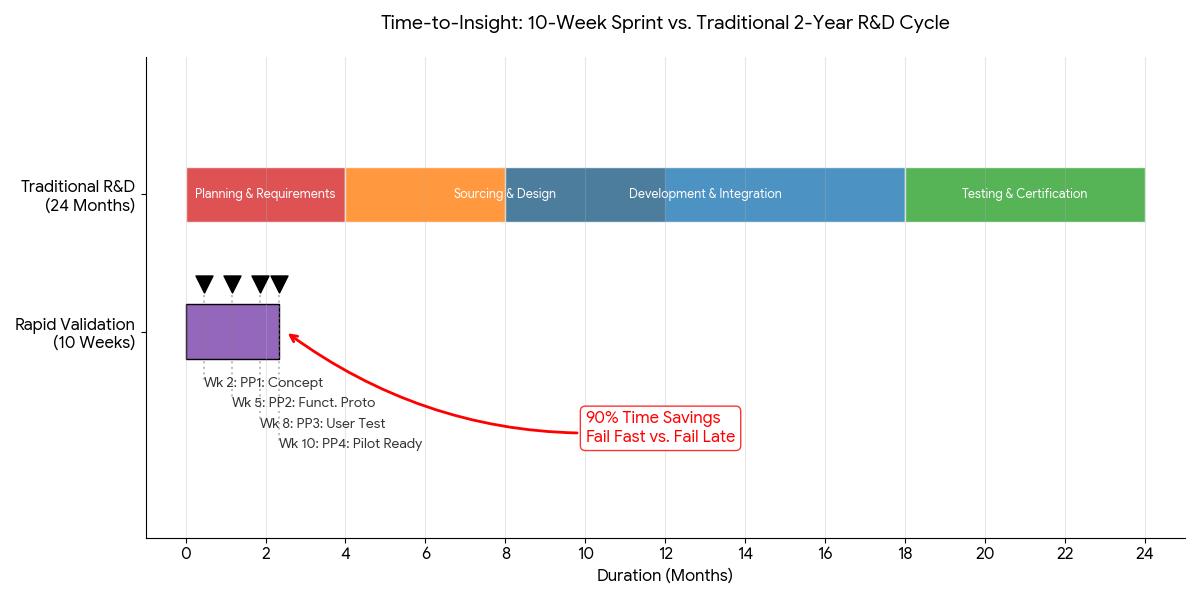
KRAFT doesn’t ask for binary trust. It builds trust through four validated checkpoints:
- Proof of Needs (Week 2-4): Evidence that validated requirements exist
- Proof of Opportunity (Week 4-8): Evidence of viable strategic opportunity
- Proof of Concepts (Week 8-12): Evidence of technical feasibility
- Proof of Profit (Week 12-16): Evidence of business value
When that automotive OEM’s R&D team reached Proof of Concepts, they didn’t just have an AI prediction. They had thermal modeling, competitive benchmarking, physics validation, and customer research—all synthesized in 10 weeks instead of 24 months. The engagement generated three patent disclosure-ready concepts.
This transforms the question from “do I bet everything on AI?” to “does the evidence at this checkpoint justify the next phase?”
Trust is progressive, not binary.
The Bet That’s Bigger Than It Looks
But let’s be honest about what’s really happening here.
Fortune 500 engineering leaders aren’t just deciding whether to trust an AI platform. They’re deciding whether to trust that software can reason about physical reality well enough to replace hardware experiments.
That’s not a purchasing decision. That’s a philosophical stance.
And if they’re wrong—if they greenlight a concept based on AI validation and it fails spectacularly—they won’t just lose the budget. They’ll lose credibility. They’ll become the cautionary tale about “the time we let an algorithm make engineering decisions.”
So the resistance isn’t irrational. It’s actually quite reasonable given the stakes.
The companies that move first will either look like visionaries or cautionary tales. There’s no middle ground.
When the Shift Becomes Inevitable
The irony is that this mental shift will happen—not because AI gets better at prediction, but because the alternative becomes untenable.
At some point, the cost of prototype-first R&D will exceed even the worst-case risk of AI-validated concepts. When your competitor is validating 40 concepts in parallel while you’re building one prototype in sequence, the question stops being “can we trust AI?” and starts being “can we afford not to?”
That’s when validation-first stops feeling reckless and starts feeling like survival.
The water’s heating up, fellow engineers.
So here’s the real question: If your competitor validated 40 battery concepts in the time you built one prototype—and one of those 40 becomes the industry standard—does it matter that you “followed the process”?
Because someone’s going to be first. And first mover in Upstream Intelligence isn’t just a competitive advantage—it’s the difference between defining the category and licensing someone else’s IP.
Popular Post

Tue August, 2025

1 Mins read
Collection series - 2021 Want more innovation? Sridhar, Founder & Chief Integrator of Innovation Enabler, discusses creativity and innovation. He… See more
Sridhar DP
Founder's Desk

Tue June, 2025
9 Mins read
Future-proofing enterprises through quantum-AI resilience. The Board is No Longer Boardroom Let me paint you a future that's already here.… See more
Sridhar DP
Founder's Desk

Shaping the Future with Heartificial Intelligence: My Vision from the 2018 Innovation 4.0 Conference
Read
Mon May, 2025
2 Mins read
Originally written in sris.blog In 2018, alongside my colleague Dr. Kiran BS, I presented a visionary concept at the prestigious… See more
Mon May, 2025
4 Mins read
In a recent article titled "I love electric vehicles – and was an early adopter. But increasingly I feel duped,"… See more
Quantum leaps - : Latest innovation breakthroughs and stratagies , delivered to your inbox .


© 2025 kreat Inc., All Rights Reserved.
Privacy & TermsKreat.ai uses cookies to offer you a better experience. See Cookie Notice for details
Kreat.ai uses cookies to offer you a better experience. See Cookie Notice for details.